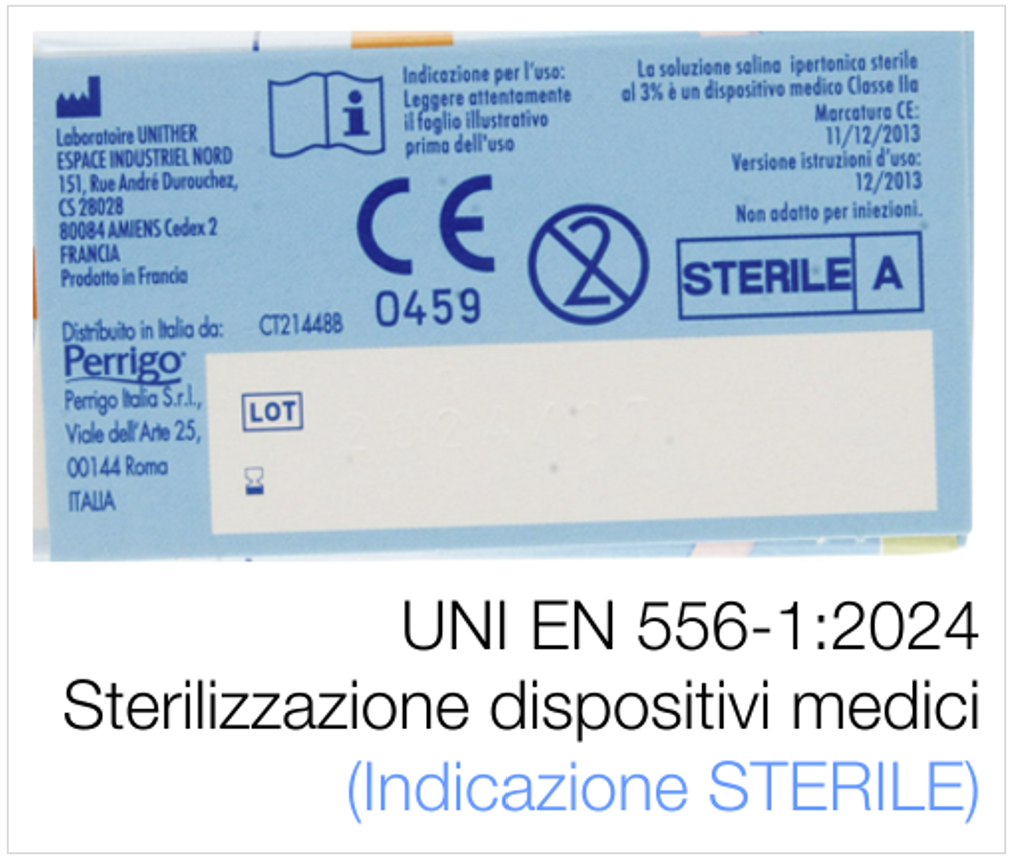
UNI EN 556-1:2024 / Sterilizzazione dei dispositivi medici (Indicazione STERILE)
ID 26426 | 10 Giugno 2026 / Preview allegato
UNI EN 556-1:2024
Sterilizzazione dei dispositivi medici - Requisiti per i dispositivi medici che recano l'indicazione "STERILE" - Requisiti per i dispositivi medici sterilizzati terminalmente
Data disponibilità: 12 settembre 2024
La norma specifica i requisiti per indicare "STERILE" un dispositivo medico sottoposto a sterilizzazione terminale.
La norma è armonizzata per il Regolamento Dispositivi medici (Regolamento (UE) 2017/745) - Decisione di esecuzione (UE) 2025/681 (GU L 2025/681 del 9.4.2025).
_________
This document (EN 556-1:2024) has been prepared by Technical Committee CEN/TC 204, Sterilization of medical devices, the secretariat of which is held by BSI.
This European Standard shall be given the status of a national standard, either by publication of an identical text or by endorsement, at the latest by January 2025, and conflicting national standards shall be withdrawn at the latest by January 2025.
Attention is drawn to the possibility that some of the elements of this document may be the subject of patent rights. CEN shall not be held responsible for identifying any or all such patent rights.
This document supersedes EN 556-1:2001 and EN 556-1:2001/AC:2006.
This document has been prepared under a Standardization Request given to CEN by the European Commission and the European Free Trade Association, and supports essential requirements of EU Directive(s) / Regulation(s). For relationship with EU Directive(s) / Regulation(s), see informative Annexes ZA and ZB, which is an integral part of this document.
EN 556, Sterilization of medical devices - Requirements for medical devices to be designated “STERILE”, is currently composed with the following parts:
- Part 1: Requirements for terminally sterilized medical devices [this document];
- Part 2: Requirements for aseptically processed medical devices.
EN 556-1:2024 includes the following significant technical changes with respect to EN 556-1:2001 and EN 556-1:2001/AC:2006:
- definitions have been aligned with EN ISO 11139;
- the normative reference has been updated to the latest edition;
- informative Annex ZA has been replaced with informative Annexes ZA and ZB giving the relationship with the European Regulations for medical devices and in vitro diagnostic medical devices respectively;
- the Bibliography has been updated.
Any feedback and questions on this document should be directed to the users’ national standards body. A complete listing of these bodies can be found on the CEN website.
Introduction
A sterile product item is one which is free of viable microorganisms. European standards for medical devices require, when it is necessary to supply a sterile product item, that adventitious microbiological contamination of a medical device from all sources is minimized by all practical means.
Even so, product items produced under standard manufacturing conditions in accordance with their requirements for quality management systems for medical devices (see EN ISO 13485:2016 and EN ISO 13485:2016/A11:2021) can, prior to sterilization, have microorganisms on them, albeit in low numbers. Such product items are non-sterile.
The purpose of sterilization processing is to inactivate the microbiological contaminants and thereby transform
the non-sterile items into sterile ones.
The inactivation of a pure culture of microorganisms by physical and/or chemical agents used to sterilize medical devices often approximates to an exponential relationship; inevitably this means that, regardless of the extent of treatment applied, there is always a finite probability that a microorganism will survive.
For a given treatment, the probability of survival is determined by the number and resistance of microorganisms and by the environment in which the organisms exist during treatment. It follows that the sterility of any one item subjected to sterilization processing cannot be guaranteed and the sterility of the processed items has to be defined in terms of the probability of the existence of a surviving microorganism on/in an item.
The standards for quality management systems recognize that there are processes used which cannot be fully verified by subsequent inspection and testing of product. Sterilization is an example of such a process.
Sterilization processes are validated before use, the performance of the process monitored routinely and the equipment maintained.
It is important to be aware that exposure to a properly validated and accurately controlled sterilization process is not the only factor associated with the provision of assurance that the product item is sterile and, in this respect, suitable for its intended use.
Attention has also to be given to a number of factors including the microbiological status (bioburden) of incoming raw materials and/or components, their subsequent storage and to the control of the environment in which the product is manufactured, assembled and packaged.
...
Medical device to be designated "STERILE"
...
4. Requirements
4.1 For a terminally sterilized medical device to be designated "STERILE", the probability of there being a viable micro-organism present on/in the device shall be equal to or less than 1 x 10⁻⁶.
NOTE 1 Permission for acceptance of a probability greater than that specified in 4.1 may be sought through the appropriate regulatory bodies. Such permission requires consideration of the individuai situation, including consideration of the risk management process (see, for example, EN ISO 14971) undertaken by the manufacturer of the medical device.
...
NOTE 2 IS0/TS 19930 provides guidance on identifying the aspects to be considered as part of a risk-based approach to selecting a sterility assurance level (SAL) for terminally sterilized, single-use health care product that is unable to withstand processing to achieve maximally a SAL of 10-6.
Collegati
Allegati
|
Descrizione |
Lingua |
Dimensioni |
Downloads |
 |
|
EN |
3127 kB |
9 |