ISO/IEC 17020:2026 / Conformity assessment - Requirements for bodies performing inspection
ID 25932 | Update 28.04.2026 / Preview attached
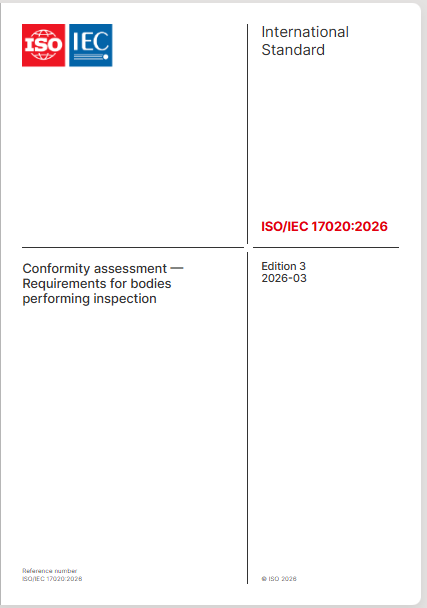
ISO/IEC 17020:2026
Conformity assessment - Requirements for bodies performing inspection
ISO/IEC 17020 specifies the requirements for the competence, impartiality and consistent operation of inspection bodies.
Inspection is the examination of an item such as materials, products, installations, plants, processes, work procedures or services, and the determination of their conformity with requirements. These requirements can come from standards, regulations, contracts or internal specifications. Inspection can cover aspects such as safety, quality, quantity and fitness for purpose.
The standard applies to inspection activities across the entire lifecycle of an item, from design to operation, and supports the delivery of reliable inspection results to clients, regulators and other stakeholders.
27.04.2026 Pubblicata UNI CEI EN ISO/IEC 17020:2026
UNI CEI EN ISO/IEC 17020:2026
Valutazione della conformità - Requisiti per gli organismi che eseguono ispezioni
La norma contiene requisiti di competenza e imparzialità degli organismi che eseguono ispezioni e del regolare e coerente svolgimento delle loro attività di ispezione.
Data entrata in vigore: 27 aprile 2026
Sostituisce: UNI CEI EN ISO/IEC 17020:2012
Recepisce: EN ISO/IEC 17020:2026
Adotta: ISO/IEC 17020:2026
Why is ISO/IEC 17020 important?
Inspection plays a critical role in risk management. It helps detect defects, verify compliance and ensure that products, systems and processes are safe and fit for use.
ISO/IEC 17020 ensures that inspection bodies operate in a competent, consistent and reliable way. By defining requirements for competence and impartiality, it builds trust in inspection results and supports their acceptance across markets and regulatory environments.
ISO/IEC 17020 can be used as a requirements document for accreditation or peer-assessment or other assessments.
Benefits
- Promotes confidence about and acceptance of inspection results by clients, regulatory authorities through the requirements for competence, impartiality and consistent operation of inspection bodies
- Supports risk management by enabling early detection of issues, nonconformities and ensuring items are safe to use
- Facilitates international recognition and acceptance of inspection outcomes
- Improves consistency and reliability of inspection processes
- Recognised reference for accreditation and peer assessment of inspection bodies
_________
FAQ
What types of inspection activities are covered?
The standard covers inspection of materials, products, plants, installations, processes, services and more, across all stages of their lifecycle, including design, operation and maintenance.
What changed in the latest version of ISO/IEC 17020?
The main change is the simplification of independence categories from three types (A, B and C) to two types: Type A and Type non-A. This reduces ambiguity and improves practical application. The revision also introduces risk-based thinking, more flexibility in requirements and new provisions on data and information control.
[...]
ISO/IEC 17020:2026
Conformity assessment - Requirements for bodies performing inspection
Introduction
This document was developed to promote confidence in bodies performing inspection.
Inspection bodies perform inspection activities on behalf of private clients, their parent organizations, regulatory authorities, or others, with the objective of providing information about the conformity of inspected items with regulations, standards, specifications, inspection schemes or contracts. Inspection parameters include matters of quantity, quality, safety, fitness for purpose, and conformity of inspected item(s) with specified requirements (e.g. safety compliance of installations or systems in operation). This document provides requirements for the competence, impartiality and consistent operation of inspection bodies as a basis to promote confidence about and acceptance of inspection results by clients, regulatory authorities and others.
This document covers the activities of inspection bodies whose work can include the examination of materials, products, installations, plants, processes, work procedures or services, and the determination of their conformity with requirements and the subsequent reporting of results of these activities to clients and, when required, to regulatory authorities. Inspection can concern all stages during the lifetime of these items, including the design stage. Such work normally requires the exercise of professional judgement in performing inspection, in particular when assessing conformity with general requirements.
This document can be used as a requirements document for accreditation or peer-assessment or other assessments.
The requirements of this document can be interpreted when applied to particular sectors.
Inspection can be an activity embedded in a larger process. For example, inspection can be specified as a surveillance activity in a product certification scheme. Likewise, results of other conformity assessment activities can be used as an input when performing inspection activities. Inspection can be an activity that precedes maintenance or simply provides information about the inspected item with no determination of conformity with requirements.
The categorization of inspection bodies as type A and type non-A reflects the level of their independence. The impartiality requirements are equally applicable to both type A and type non-A inspection bodies.
1 Scope
This document contains requirements for the competence and impartiality of bodies performing inspection, and for the consistent operation of their inspection activities.
2 Normative references
The following documents are referred to in the text in such a way that some or all of their content constitutes requirements of this document. For dated references, only the edition cited applies. For undated references, the latest edition of the referenced document (including any amendments) applies.
ISO/IEC 17000:2020 Conformity assessment - Vocabulary and general principles
3 Terms and definitions
For the purposes of this document, the terms and definitions given in ISO/IEC 17000 and the following apply.
ISO and IEC maintain terminology databases for use in standardization at the following addresses:
- ISO Online browsing platform: available at https://www.iso.org/obp
- IEC Electropedia: available at https://www.electropedia.org/
3.1
inspection
examination of an item (3.8) and determination of its conformity with detailed requirements or, on the basis of professional judgement, with general requirements
Note 1 to entry: Examination can include direct or indirect observations, which can include measurements or the output of instruments.
Note 2 to entry: Inspection results normally include a statement of conformity regarding the item. However, schemes or contracts can specify inspection as examination only.
[SOURCE:ISO/IEC 17000:2020, 6.3, modified - In the definition, "object of conformity assessment" has been replaced by "item"; the original Notes 2 and 3 to entry have been removed; a new Note 2 to entry has been added.]
3.2
inspection body
body that performs inspection (3.1)
3.3
inspection scheme
inspection programme
set of rules and procedures that describes the item (3.8), identifies the specified requirements and provides the methodology for performing inspection (3.1)
Note 1 to entry: Inspection schemes can be operated at the international, regional, national, sub-national or industry sector level.
Note 2 to entry: A scheme that includes inspection can provide methodology for activities in either all or only in some of the conformity assessment functions (see ISO/IEC 17000:2020, Annex A).
It can include methodology for inspection only (a determination function activity) or for other determination function activities. The scheme can include methodology for selection function activities and, in addition, it can include methodology for review, decision, attestation function activities
Note 3 to entry: The inspection scheme can specify independence requirements.
[SOURCE:ISO/IEC 17000:2020, 4.9, modified - In the preferred term and the admitted term, "conformity assessment" has been replaced by "inspection"; in the definition, "objects of conformity assessment" has been replaced by "item"; "conformity assessment" has been replaced by "inspection"; the original three Notes to entry have been replaced by three new ones.]
3.4
impartiality
objectivity with regard to the outcome of an inspection (3.1)
Note 1 to entry: Objectivity means that conflicts of interest do not exist or are resolved so as not to adversely influence activities of the inspection body (3.2).
Note 2 to entry: Other terms that are useful in conveying the element of impartiality are: freedom from conflict of interests, freedom from bias, lack of prejudice, neutrality, fairness, open-mindedness, even-handedness, detachment, balance.
[SOURCE:ISO/IEC 17000:2020, 5.3, modified — In the definition, "conformity assessment activity" has been replaced by "inspection"; Note 1 to entry has been changed and Note 2 to entry has been added.]
3.5
appeal
request by the client (3.7) to an inspection body (3.2) for reconsideration by that body of a decision it has made relating to the conformity of the item (3.8) inspected
Note 1 to entry: An appeal is only possible if a statement of conformity has been issued.
[SOURCE:ISO/IEC 17000:2020, 8.6, modified — In the definition, "person or organization that provides, or that is, the object of conformity assessment to a conformity assessment body or an accreditation body" has been replaced by "client to an inspection body"; "that object" has been replaced by "the conformity of the item inspected"; Note 1 to entry has been added.]
3.6
complaint
expression of dissatisfaction, other than appeal (3.5), by any person or organization to an inspection body (3.2), relating to the activities of that body, where a response is expected
[SOURCE:ISO/IEC 17000:2020, 8.7, modified — In the definition, "a conformity assessment body or an accreditation body" has been replaced by "an inspection body".]
3.7
client
person or organization requesting inspection (3.1) of an item (3.8)
Note 1 to entry: The client can be different from the provider of the item.
3.8
item
object of inspection (3.1) to which the specified requirements for the inspection apply
Note 1 to entry: The term “item” is used in this document to encompass product, process, service, material, location, facility, premises, installation, or parts of thereof, or their design, as appropriate.
Note 2 to entry: The object of inspection can be a group of objects or a single object.
Note 3 to entry: An item can be inspected at any stages, e.g. design stage, type examination, initial inspection, in-service inspection or under surveillance.
Note 4 to entry: Inspection of processes can include personnel, facilities, technology or methodology.
[...]
Fonte: ISO
Allegati
|
Descrizione |
Lingua |
Dimensioni |
Downloads |
 |
|
EN |
745 kB |
3 |