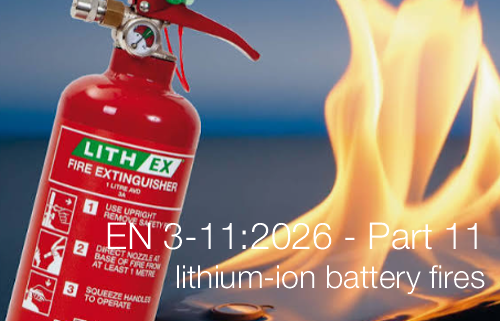
EN 3-11:2026 - Portable fire extinguishers / lithium-ion battery
ID 27409 | 03 Novembre 2026 / Preview allegata (EN)
EN 3-11:2026
Portable fire extinguishers - Part 11: Additional requirements to EN 3-7 for the test method and marking of extinguishers suitable to be used on small rechargeable lithium-ion battery fires
This document specifies performance requirements for portable fire extinguishers in addition to the requirements of EN 3 7, to demonstrate their suitability for extinguishing fires in rechargeable batteries based on lithium-ion chemistry with a maximum capacity of 600 Wh, as used for example:
- portable electronic equipment (smartphones, laptops);
- power tools and domestic appliances;
- portable medical equipment;
- toys and radio-controlled objects;
- drones;
- bicycles.
This document contains general requirements and procedures for extinguishing tests. The size of the extinguishing tests is comparable to the battery capacities in the above mentioned applications where the battery is accessible. This document doesn’t apply to larger fire risks, such as vehicle batteries, fork lift trucks, and battery sets of stationary energy storage systems.
EN 3-11:2026 is a CEN standard for portable fire extinguishers that adds requirements to EN 3-7 for testing and marking extinguishers used on small lithium-ion battery fires. It covers extinguishers intended for battery fires up to a nominal capacity of 600 Wh, such as those in portable electronics, power tools, medical equipment, toys, drones and bicycles.
The document is aimed at proving that a specific extinguisher model, with a specific extinguishing agent, is suitable for this battery-fire risk and how that suitability is marked on the product.
What does EN 3-11:2026 specify?
EN 3-11:2026 specifies extra performance requirements, a test method and marking rules for portable fire extinguishers used on lithium-ion battery fires. It builds on EN 3-7 and uses extinguishing tests on pouch-cell battery assemblies to show suitability for this specific fire scenario.
The document is organized into six clauses and three annexes.
| Annex |
What it covers |
| Annex A |
Normative extinguishing tests, including material, test set-up, ignition, execution and pass/fail criteria |
| Annex B |
Informative model test report |
| Annex C |
Informative safety precautions during testing |
The scope ties the tests to smaller battery capacities in common portable applications. It also excludes validation for larger risks such as vehicle batteries and stationary energy storage battery sets.
What are the key requirements of EN 3-11:2026?
EN 3-11:2026 requires the extinguisher to satisfy EN 3-7 first, then adds battery-fire testing, product documentation and marking rules. In practice, this means the product has to pass both the base extinguisher standard and the additional lithium-ion battery test program.
General product requirements
- The portable fire extinguisher shall meet EN 3-7 requirements, including an A-rating and successful dielectric testing. This matters because the product must already be a compliant extinguisher before it is assessed for battery fires.
- Before testing starts, a complete product file shall be submitted. It includes the extinguisher technical datasheet, parts and assembly drawings, extinguishing-agent datasheet, analysis report and safety datasheet. This gives the test institute traceable evidence for the exact product and agent tested.
Suitability for lithium-ion battery fires
- Suitability is demonstrated by extinguishing tests on combined flat pouch cells according to Annex A. The test method is therefore focused on a battery-pack fire scenario, not on ordinary solid, liquid or gas fires.
- The fire rating is expressed as nominal capacity in Wh. For the 600 Wh rating, the maximum extinguishing-agent quantity is 9 l. This tells the user what battery size the extinguisher was shown to handle.
- A portable fire extinguisher is suitable only if the extinguishing tests in Annex A are successfully completed. The result depends on both the free burn test and the extinguishing tests.
Test method and pass criteria
- Annex A uses new NMC pouch cells from one production batch for each test series, and the cell capacity is verified against the datasheet. This keeps the test consistent and tied to a known battery type.
- The test series includes one or two free burn tests and two or three extinguishing tests. The free burn test confirms the battery assembly behaves as expected before extinguishing is assessed.
- The extinguishing test has a 3 min limit from ignition of the first cell, followed by a 20 min observation period with no re-ignition. At the end, at least one set must remain unignited and at least one cell in that set must still deliver at least 3.7 V.
- A test series is successful when the free burn test and at least two extinguishing tests pass. If the first two extinguishing tests pass, the third is not needed.
Marking
- If the requirements are met, the extinguisher shall carry a suitability marking on the front in a clearly visible position, outside the EN 3-7 marking area. The marking includes the battery icon, the word Li, the demonstrated fire rating in Wh and the standard reference.
- A pictogram is also required in Part 2 as defined by EN 3-7, and it may only be used when the corresponding fire rating appears on the marking. This helps users match the extinguisher to the battery-fire application.
What terms does EN 3-11:2026 define?
EN 3-11:2026 defines the basic battery terms used in the test method and scope.
- Cell - a single source of electrical energy obtained by converting chemical energy.
- Battery - a set of interconnected battery cells in a common enclosure.
- Pouch cell - a flat battery cell with internal components stacked and packed in plastic foil.
- NMC - nickel manganese cobalt oxide, used here as the chemistry identification for the lithium battery cells.
- Thermal runaway - the uncontrolled reaction described in the introduction where heat release causes adjacent cells to ignite and the fire to spread through the battery pack.
Who uses EN 3-11:2026?
EN 3-11:2026 is used by fire extinguisher manufacturers, test institutes and compliance teams that need to show a product is suitable for lithium-ion battery fires. It is also relevant to certification bodies and product developers who specify extinguishers for workplaces, service vehicles or equipment areas where small battery fires are a known risk.
It matters for industries using portable lithium-ion batteries in electronics, tools, domestic appliances, medical devices, toys, radio-controlled products, drones and bicycles. For these users, the standard helps connect a product claim to a defined test and marking method.
Which standards are used with EN 3-11:2026?
EN 3-11:2026 uses EN 3-7:2004+A1:2007 as its normative basis. EN 3-7 provides the general portable fire extinguisher characteristics, performance requirements and test methods that remain applicable before the extra lithium-ion battery-fire requirements are checked.
What does the EN 3-11:2026 document contain?
EN 3-11:2026 contains the scope, normative references, terms and definitions, general product requirements, suitability testing, and marking rules. It also includes the detailed normative test method in Annex A, so the reader can see how the battery cells are prepared, how ignition is triggered, how the extinguisher is used, and how success is judged.
Annex B provides a model test report that captures the extinguisher identity, test results and supporting documents. Annex C gives safety precautions for the test site, including personal protection, insulated tools, battery handling and the role of a safety officer.
[...]
Collegati
Allegati
|
Descrizione |
Lingua |
Dimensioni |
Downloads |
 |
|
EN |
794 kB |
0 |