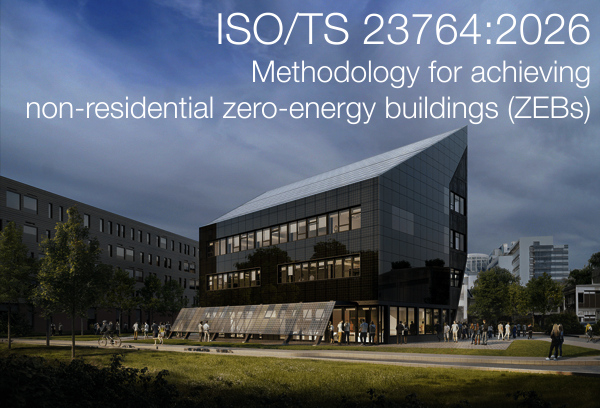
This document aims to apply a methodology for achieving a zero-energy building (ZEB).
Since the Paris Agreement was adopted in the 21st Session of the Conference of the Parties to the United Nations Framework Convention on Climate Change, all member countries (including emerging countries) have been required to set a target for reducing their greenhouse gas emissions by 2020 and later. In all countries, reducing energy consumption is the most effective means of mitigating greenhouse gas emissions.
The building sector takes a 30 % share of the world’s energy consumption, and this contribution appears to be increasing.
Therefore, reducing the greenhouse gas emissions from this sector is an important global issue. Ultimately, the energy consumption of the building must be reduced and balanced by renewable energy to create a (net) ZEB. Such advanced cases have already been constructed.
Although the ultimate goal of achieving ZEBs is clearly understood, its realization has been limited by practical barriers such as high initial investment. However, as the life cycle of buildings is long, the design and construction of more energy-efficient buildings is considered as a present attempt rather than a future one for greenhouse gas reduction. Hence, accelerating the movement toward ZEBs is an immediate urgency.
From this perspective, this document advocates a step-by-step realization approach for (net) ZEBs. Its aim is to accelerate the ZEB movement and describe the practical realization of ZEBs. Namely, this document proposes a practical ZEB approach and outlines the basic considerations during the complete process of ZEB realization, from design to the operation and maintenance stages.
To accelerate the reduction of greenhouse gases, this document aims to contribute policies and/or guidelines for disseminating ZEBs that suit the conditions of individual countries, especially those of emerging countries undergoing rapid urbanization.
To assist understanding of the contents of this document, the following four ZEB examples are included as annexes:
a) (net) ZEB results of evaluating a ZEB office building that is superior in terms of comfort and health, a ZEB integrated warehouse, and a ZEB office building with interactive exhibition gallery and a renovation centre (see Annexes A, B and C);
b) nearly ZEB results of evaluating a ZEB retail complex (see Annex D);
c) ZEB Ready results of an urban medium-sized office (see Annex E).
NOTE 1 One example (net) ZEB (Annex A) is SUSTIE Building.
NOTE 2 Three examples (Annex B, C and D) toward realizing ZEB were selected from the cases awarded in the ASEAN Energy Award
NOTE 3 The ZEB Ready example, the KT Building, was selected from the Net Zero Energy Building Advanced Case Collection published by The Society of Heating, Air-Conditioning and Sanitary Engineers of Japan (SHASE).
1 Scope
This document provides a basic step-by-step approach for achieving non-residential (net) zero-energy buildings (ZEBs). It also describes the basic concept of ZEBs and the items for consideration in this approach.
The following are within the scope of this document:
- application to non-residential buildings;
- annual energy consumption of a ZEB (this includes the operating consumption of the building and excludes the energy consumed by the manufacturing of materials and equipment, and the energy consumed during construction);
- renewable energy supply (this can be on-site or off-site, depending on the policy and conditions of the country in which the supply is installed);
- application to any climate zone.
The following are out of the scope of this document:
- recommendations or suggestions for the adoption of any specific technologies or equipment, or both, and materials that are expected to be continuously innovated (however it does stipulate the technologies for selection);
- specific methods or calculation formulae for design;
- commissioning methods.
...
add Preview
Collegati