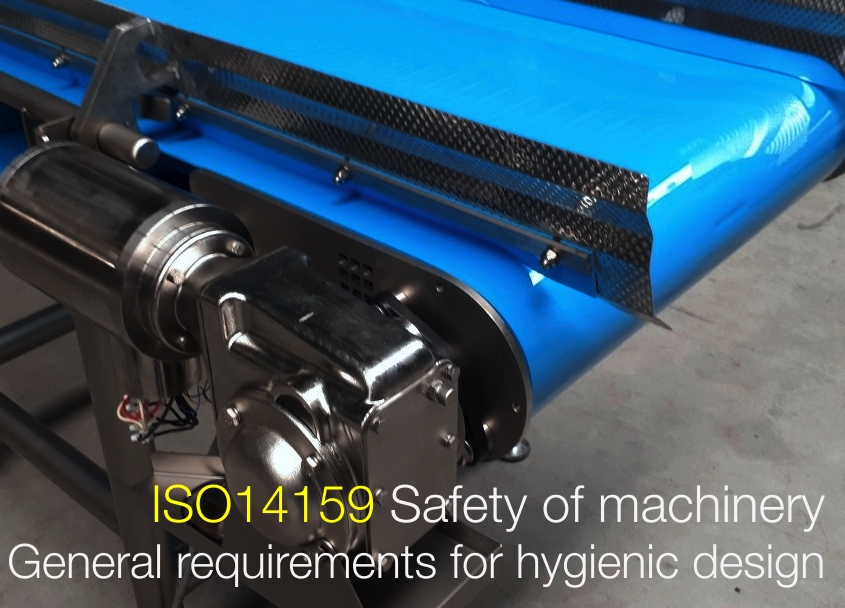
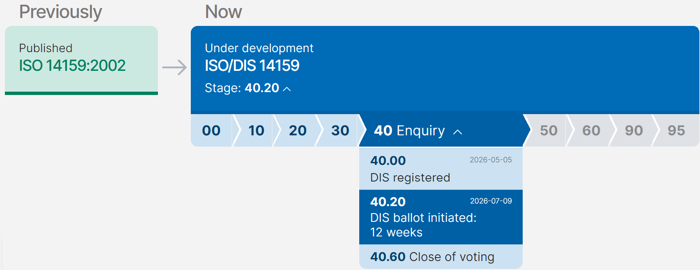
ISO/DIS 14159 / General requirements for hygienic design of machinery - Status 40.20 (DIS Ballot)
ID 26826 | 05 Agosto 2026 / Preview attached
ISO/DIS 14159
Safety of machinery - General requirements for hygienic design
_________
This document was prepared by Technical Committee ISO/TC 199 Safety of machinery.
This second edition cancels and replaces the first edition ISO 14159:2002-04-01 Safety of machinery – Hygiene requirements for the design of machinery, which has been technically revised.
The main changes are as follows:
- References, terms and definitions were updated
- New clause 5 “Hygiene requirements and hygiene measures”
- Clause 6 “Hygiene Risk reduction” was structured in product-, splash- and non-product area
- Informative Annexes A, C were deleted and replaced by
Annex A Examples of potential risks and possible solution
Annex B Examples of hygiene hazard
Any feedback or questions on this document should be directed to the user’s national standards body. A complete listing of these bodies can be found at www.iso.org/members.html.
Introduction
This International Standard is one of a series of standards relating to the safety of machinery (ISO 12100:2010). It is a Type B standard and as such very general.
This document does not deal with the hygiene-related risks to operators arising from the use of the machinery.
Hygiene risks are associated with the ability of a machine to prevent product contamination and to be freed from product debris and microorganisms that can compromise the health and safety of persons or domestic animals.
This standard considers machinery and their associated equipment and can be used to provide guidance to the manufacturers of machines, associated equipment and other equipment where hygiene risks to the consumer of the products can occur. Type C standard applicable to specific machines types can implement or modify the requirement of this standard. Furthermore, detailed B standards with requirements for specific sectors of machinery - depending on identified hazards - can be deduced on basis of this general Type B standard.
It is applicable to all machines and associated equipment in applications where hygiene risks to the consumer of the product can occur (e.g.: food, feed,beverages, pharmaceuticals, biotechnological products, cosmetics). Other standards, for example machinery specific Type C standards, may be required to provide guidance for specific types of equipment and/or for specific industry sectors. Furthermore, detailed B standards with requirements for specific sectors of machinery - depending on identified hazards - can be deduced on basis of this general Type B standard.
When no design or safeguarding options are within the state of the art to adequately control both hygiene and safety risks, then one of the risks, or both, would have to be dealt with by residual safeguards, including instructions to the user. The assessment of the respective safety and hygiene risks shall indicate their relative significance, and the highest level of protection (i.e. safeguarding) shall be implemented to deal with the severest risk, and residual safeguards shall be used for the lesser risk. This standard deals in particular with hygiene risks but also considers the possible conflict between safety and hygiene measures.
The technical solutions given in this International Standard permit both objectives to be met for those significant and common risks identified as justifying common requirements specified in this International Standard.
1 Scope
This International Standard specifies general requirements for the hygienic design of machinery and associated equipment as well as instructions for use. It applies to all types of machines and associated equipment used in applications where hygiene risks to the consumer of the product can occur.
This International Standard does not cover requirements relative to the egress of microbiological agents from the machine.
...
Life cycle
Preview attached
Collegati
Allegati
|
Descrizione |
Lingua |
Dimensioni |
Downloads |
 |
|
EN |
164 kB |
0 |