Safe and Sustainable by Design Chemicals and Materials / JRC 2025
ID 25322 | 14.01.2026 / Attached
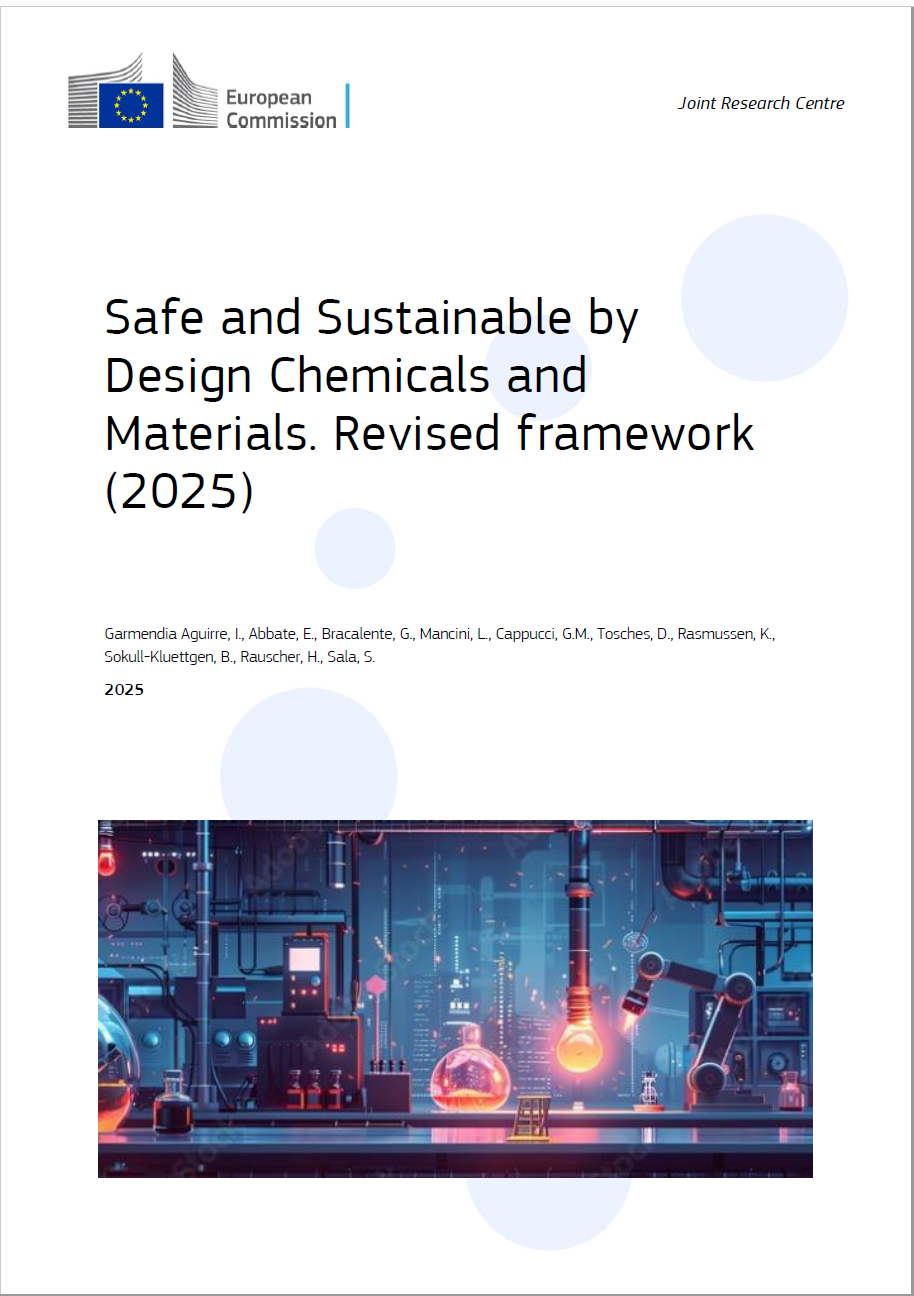
Safe and Sustainable by Design Chemicals and Materials. Revised framework (2025)
The Safe and Sustainable by Design (SSbD) framework for chemicals and materials was proposed by the JRC in 2022, supporting the related European Commission Recommendation of 2022. Those have been tested in different contexts and by different stakeholders, providing indications towards an SSbD revision. This revised SSbD framework has the following main novel aspects:
1. It introduces the concept of “SSbD fundamentals”, as backbone of the framework, to enhance clarity.
2. Scoping analysis: The starting point of the assessment, which is the process of identifying and prioritising the key issues associated with a project which need to be assessed. As already been introduced in the methodological guidance, the scoping analysis is more specified and structured, towards defining scenarios to tailor the application of the SSbD. Emphasis is given to the importance of engaging with the actors along the life cycle. Methodological criteria are proposed to guide SSbD practitioner to the adherence to SSbD fundamentals.
3. New structure of the contents of the safety and sustainable assessment parts:
(a) The safety part is focused on the risk associated to the chemical/material and the related processes and uses, deriving from the combination of the evaluation of chemicals’ intrinsic properties and occupational/professional, consumer, and environmental exposure. The Steps 1, 2, 3 of the 2022 framework, are now merged in one safety part.
(b) Process-related risk throughout the supply chain part addresses aspects associated with the selected production processes to enable a comprehensive evaluation of alternative underpinning processes (e.g. different pathways to produce the same chemical/material).
(c) The environmental sustainability part addresses the entire life cycle of the chemical/material (raw materials, production, use, and disposal process) is assessed applying life cycle assessment. The part proposes screening level assessments and shortcuts to simplify the application at low TRLs, as well as benchmarks to facilitate the SSbD application.
(d) The socio-economic sustainability assessment part, which is significantly expanded compared with the 2022 framework, addresses the social fairness and competitiveness dimensions of the chemical/material supply chain. These include aspects related to supply chain vulnerabilities and life cycle costs, also linked to risk governance and financial stability.
4. Evaluation: The Framework proposes an approach to evaluate the implementation of the SSbD framework, to identify trade-offs between different aspects and uncertainties of the assessment according to the available information. An example of visualisation of the results of the evaluation is provided as a dashboard, serving as a compass to identify hotspots and critical elements to guide the innovation along the life cycle of chemicals and materials.
5. Documentation: The framework also includes a section on documentation, aiming at systematically and transparently recording the key elements for the implementation SSbD.
[...]
Fonte: JRC
Collegati
Allegati
|
Descrizione |
Lingua |
Dimensioni |
Downloads |
 |
|
EN |
7486 kB |
12 |