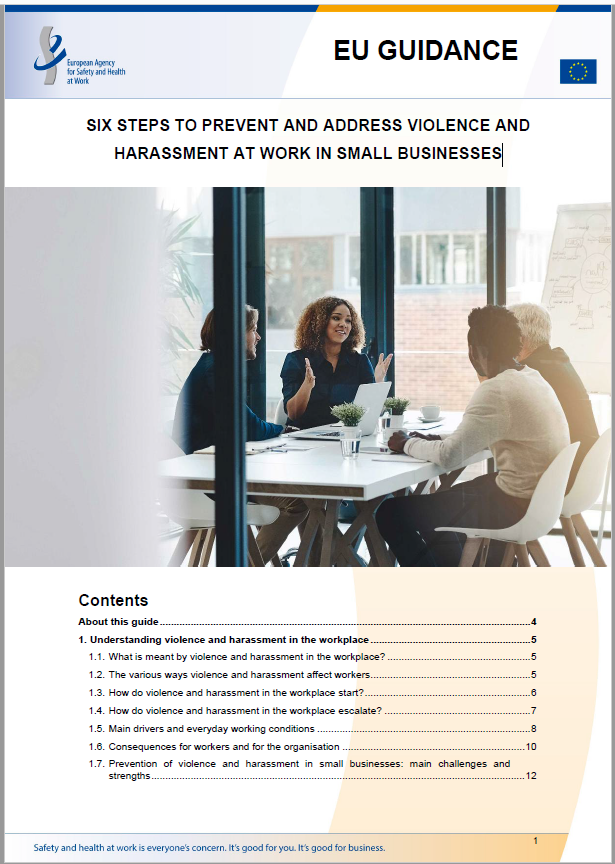
Six steps to prevent and address violence and harassment at work in small businesses / Guidance EU-OSHA 2026
ID 27602 | 25.11.2026 / Attached
Violence and harassment in the workplace represent a serious occupational risk, not merely personal conflicts between individuals. Workers who experience such behaviour may suffer harm to their mental and physical health, including stress, anxiety, sleep problems and, in more serious cases, depression, burnout or even suicide. Such behaviour can also affect work performance and the organisation more broadly, for example through reduced confidence, distraction, mistakes at work and increased sickness absence. It can also damage the wider working environment, affecting teamwork, morale and the day-to-day functioning of the organisation.
It is the employer’s responsibility to take reasonable steps to prevent violence and harassment in the workplace, respond when this behaviour occurs and protect the health, safety and dignity of workers. It is important to stress that violence and harassment can occur in any workplace, regardless of its size or sector, including small businesses. While small businesses may have fewer formal procedures or resources, they still need to manage these risks and can benefit from clear, practical guidance.
This guide provides the small business owner, employer or manager with practical support on how to prevent and respond to violence and harassment in the workplace. It explains how to identify risks, take actions and learn from experience to improve over time. It covers situations that arise between colleagues or between workers and managers, as well as situations involving customers, clients, patients, service users or members of the public. It applies to behaviour that happens in person and also through digital channels, such as email, messaging apps and phone calls. It walks the reader through a step-by-step approach to preventing violence and harassment in the workplace, offers ready-to-use tools and examples and provides guidance on how to shape them to the specific context of the organisation.
This guide is specifically built for small businesses, with realistic measures that can be applied with limited resources. Indeed, small businesses may not have dedicated human resource (HR) support or extensive time to devote to policy development. However, size can also be an advantage: decisions can be made quickly, communication is more direct and changes to everyday routines do not require multiple layers of approval.
The guide is divided into two main sections. SECTION 1 explains what is meant by violence and harassment in the workplace and the many forms this behaviour can take, how it tends to develop, what makes it more likely in everyday working conditions and the effect it can have on your workers and your organisation. It closes with a brief reflection on the particular challenges and strengths of small businesses. SECTION 2 sets out a step-by-step approach to preventing violence and harassment, including how to respond effectively when an incident occurs and improve your approach over time. Each step is designed for a small workplace and comes with practical tools and examples to adapt to the individual context of the company.
The guide has been designed to be used flexibly and does not need to be read from start to finish. Where the basic concepts are already familiar, SECTION 2 can be consulted directly, and in specific situations, the relevant step can be consulted on its own.
_____________
Contents
About this guide
1. Understanding violence and harassment in the workplace
1.1. What is meant by violence and harassment in the workplace?
1.2. The various ways violence and harassment affect workers
1.3. How do violence and harassment in the workplace start?
1.4. How do violence and harassment in the workplace escalate?
1.5. Main drivers and everyday working conditions
1.6. Consequences for workers and for the organisation
1.7. Prevention of violence and harassment in small businesses: main challenges and strengths
2. A step-by-step approach to preventing and responding to violence and harassment in the workplace
2.1. Principles to keep in mind throughout the approach
2.2. How to use this guide
Step 1 - Identify the hazards and assess the risk
Aim
Good practice example 1
Step 2 - Put preventive and control measures in place
Aim
Starting points
Longer-term actions
Good practice example 2
Step 3 - Set a clear policy and reporting procedures
Aim
Starting points
Longer-term actions
Good practice example 3
Step 4 - Build awareness, engagement and capacity to act
Aim
Starting points
Longer-term action
Good practice example 4
Step 5 - Respond to incidents effectively and support those affected
Aim
Starting points
Longer-term actions
Good practice example 5
Step 6 - Monitor, review, learn and improve
Aim
Starting points
Longer-term actions
Good practice example 6
3. Conclusions
4. Tools and resources
[...]
Fonte: EU-OSHA
Collegati
Allegati
|
Descrizione |
Lingua |
Dimensioni |
Downloads |
 |
Abbonati Sicurezza Lavoro
|
EN |
2011 kB |
0 |