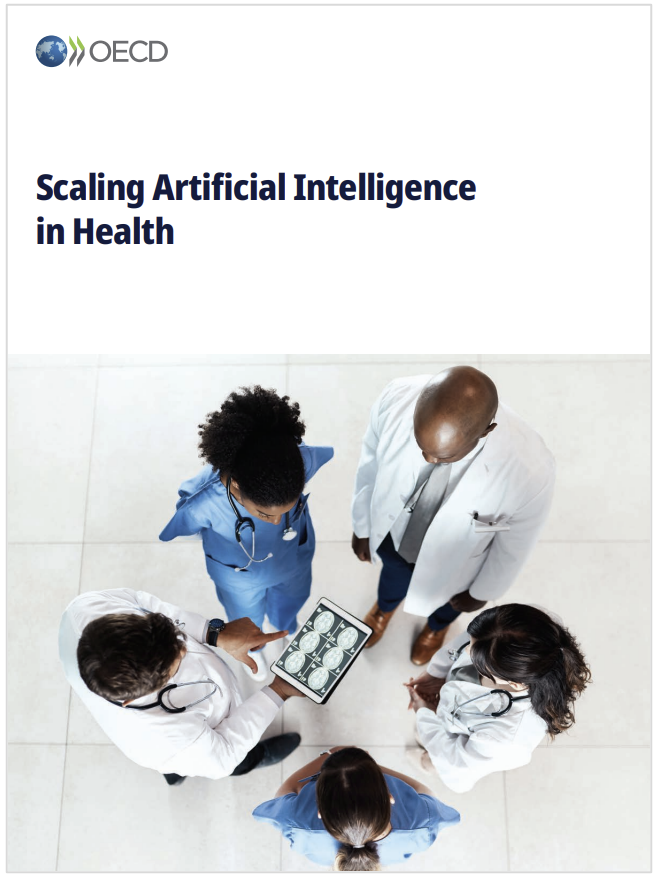
Scaling Artificial Intelligence in Health / OECD 2026
ID 25875 | 29.03.2026 / Attached
Artificial Intelligence (AI) holds significant potential for the healthcare system. That potential is not being fully realised due to fragmented data foundations, non-aligned policies and practices, and structural and governance barriers to scalability. Although AI is universally used in administration across OECD Member countries (100%), national-level scale-up remains limited, (e.g. only 10% for medical imaging
applications).
Today, there are well-documented risks associated with the use of AI in healthcare, such as skewed data, privacy and security risks, insufficient transparency or oversight, and the potential for job displacement and de-personalisation. While caution is necessary, there is also risk in inaction.
The opportunity from AI in health will be unleashed when we can responsibly scale. This requires a balance between market forces (that move fast), health culture (doing no harm), and reaching every person (through scale).
While AI is already being used in health across OECD Member countries, responsible and scalable adoption remains impacted by structural, regulatory, and governance gaps. OECD Member countries are undertaking initiatives to address these gaps:
- Establishing a strategy or action plan at the intersection of AI and health (18%),
- Establishing an oversight body for the use of AI in health (18%),
- Establishing a national approach to regulatory sandbox with a focus on AI in health (18%),
- Streamlining the national approach to health technology assessments to include AI (24%),
- Updating national procurement guidelines to account for AI in health (11%),
- Establishing national approach to improve the use of AI in the health workforce (29%), and
- Developing national legislation for AI in health (3%).
To help support these actions toward the responsible scale of AI in health, a coherent policy checklist was developed to guide decision making and prioritisation. The checklist is built on OECD AI principles and frameworks and developed in partnership with the Global Digital Health Partnership (GDHP) and Coalition for Health AI (CHAI) as well as the OECD AI in Health Expert Group.
This AI in Health Policy Checklist identifies policymaker, technologist, and health workforce actions to responsibly scale AI in health. Critically, the checklist can be used to identify blind spots in those actions.
The checklist is not prescriptive; however, it provides a prompt for decision makers to consider a full range of action across relevant policy categories and areas.
...
add attached
OECD
Collegati
Allegati
|
Descrizione |
Lingua |
Dimensioni |
Downloads |
 |
|
EN |
1824 kB |
207 |