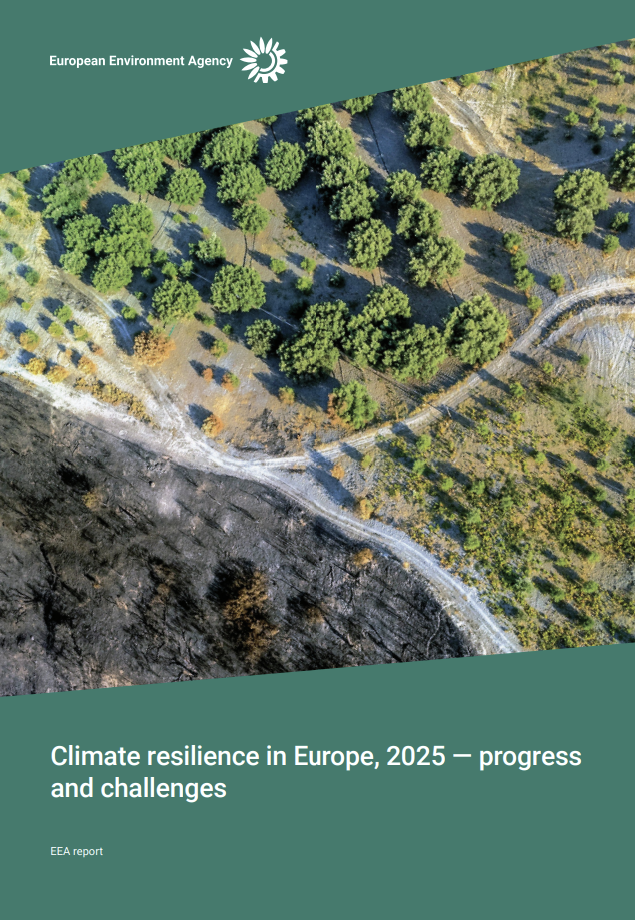
Climate resilience in Europe, 2025 - progress and challenges / EEA 2026
ID 26823 | 04 Agosto 2026 / Attached
The objective of this report is to present an analysis of European progress towards climate resilience since 2021, with an emphasis on the state of play in 2025.
The report focuses on recent policy developments, emerging challenges and lessons learned to give an overview of how policy and implementation are evolving.
_________
At least 95% of Europe′s land area experienced above-average annual temperatures in 2025, according to the European State of the Climate 2025 report (C3S/ECMWF and WMO, 2026). Across the continent, rising temperatures are accelerating the rate at which snow and ice cover are melting; meanwhile, heatwaves, drought, wildfires and marine heat are intensifying. Societies, ecosystems and the economy across Europe are all facing the consequences.
Since the 1980s, Europe has been warming at twice the global average (EEA, 2024); it is the fastest warming continent on Earth. Even with significant mitigation efforts, the climate impacts will continue to intensify. This means that climate resilience and preparedness are essential to protect people, the planet and prosperity.
This European Environment Agency (EEA) report provides a consolidated overview of reported national adaptation actions across Europe between 2021 and 2025.
It covers reporting by the 27 European Union Member States (EU-27) and voluntary contribution of three additional EEA member countries (Iceland, Switzerland and Türkiye); additionally, it includes desk research from the two other EEA member countries, Liechtenstein and Norway.
Drawing on reporting under Regulation (EU) 2018/1999 on the Governance of the Energy Union and Climate Action (referred to here as the Governance Regulation) (EU, 2018), the report assesses progress across the adaptation policy cycle: from understanding climate risks and setting policy objectives to implementing actions and monitoring, evaluation and learning (MEL). However, the data available are variable and incomplete, which limits the robustness of the assessment. As such, the report offers only partial insights into overall progress towards climate resilience.
EEA 2026
attached
Collegati
Allegati
|
Descrizione |
Lingua |
Dimensioni |
Downloads |
 |
|
EN |
18321 kB |
112 |