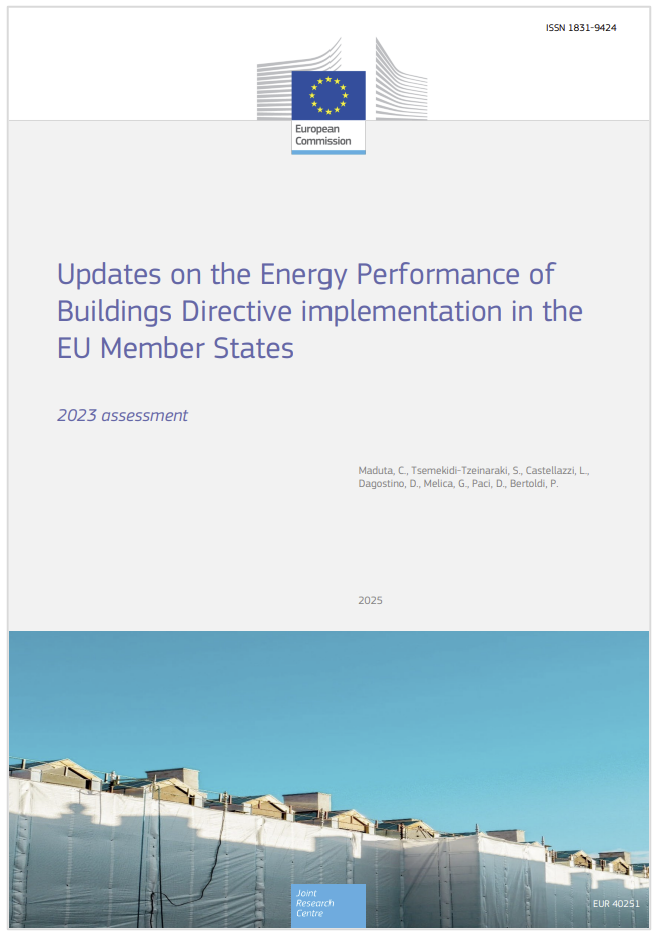
Updates on the Energy Performance of Buildings Directive implementation in the EU Member States / 2023 assessment - JRC 2025
ID 26912 | 16 Agosto 2026 / Attached
The Energy Performance of Buildings Directive (EPBD), Directive (EU) 2024/1275, is a crucial component of the European Union's (EU) strategy to achieve a fully decarbonized building stock by 2050. It works in synergy with other EU climate and energy policies, including the Energy Efficiency Directive, the Renewable Energy Directive, and the Governance Regulation, to guide improvements in building energy performance. The 2024 recast EPBD aims to ensure that buildings align with the EU's ambitious targets under the European Green Deal and the Climate Target Plan.
This report details the current progress of Member States in improving building energy efficiency and provides insights into future energy savings and emission reductions. It draws on national strategies and plans, such as Long-Term Renovation Strategies (LTRSs), integrated National Energy and Climate Progress Reports (NECPRs), Energy Performance Certificate (EPC) schemes, equivalence reports for technical building system inspection, as well as databases such as Eurostat and European Environment Agency.
From 2005 to 2022, the EU's overall residential energy consumption decreased by 23.9 Mtoe, representing a 9.0% reduction. After a notable increase in 2021, there was a decline of 17.7 Mtoe in 2022, likely due to milder winters. Residential energy consumption per capita (climatic corrected) remained relatively stable during the studied period, showing an annual average decrease of 0.03%.
In the EU services sector, energy consumption decreased by 6.3 Mtoe from 2005 to 2022. At the same time, in 2022, the energy consumption was 7.7 Mtoe lower compared to 2021, representing a 6.1% decrease. The services sector energy intensity showed improvements for the period 2005-2022, with an annual average reduction of 1.38% at the EU level. The increase in energy prices (electricity and gas) and the EU's 'Save Energy' communication, which aims at reducing reliance on fossil fuels, may also have affected the decreasing annual trends.
The EU building stock holds the potential for substantial savings in final energy consumption and direct greenhouse gas (GHG) emission reductions. Indicative LTRS targets project final energy savings of 14% and a 35% reduction in direct GHG emissions by 2030, compared to 2019 levels.
Further reductions of 41% (energy) and 94% (emissions) by 2050 are projected. When compared to 2015 GHG emission levels, the 2020 LTRS targets for 2030 fall 38% lower, which is below the 60% reduction goal set by the Climate Target Plan. However, it is worth noting that the LTRS targets were set prior to the establishment of these EU targets, and in this analysis, the LTRS GHG emission values only account for direct emissions.
...
add
JRC
Maduta, C., Tsemekidi-Tzeinaraki, S., Castellazzi, L.,
Dagostino, D., Melica, G., Paci, D., Bertoldi, P.
Collegati
Allegati
|
Descrizione |
Lingua |
Dimensioni |
Downloads |
 |
|
EN |
1421 kB |
0 |