Featured
IARC Monographs Volume 135
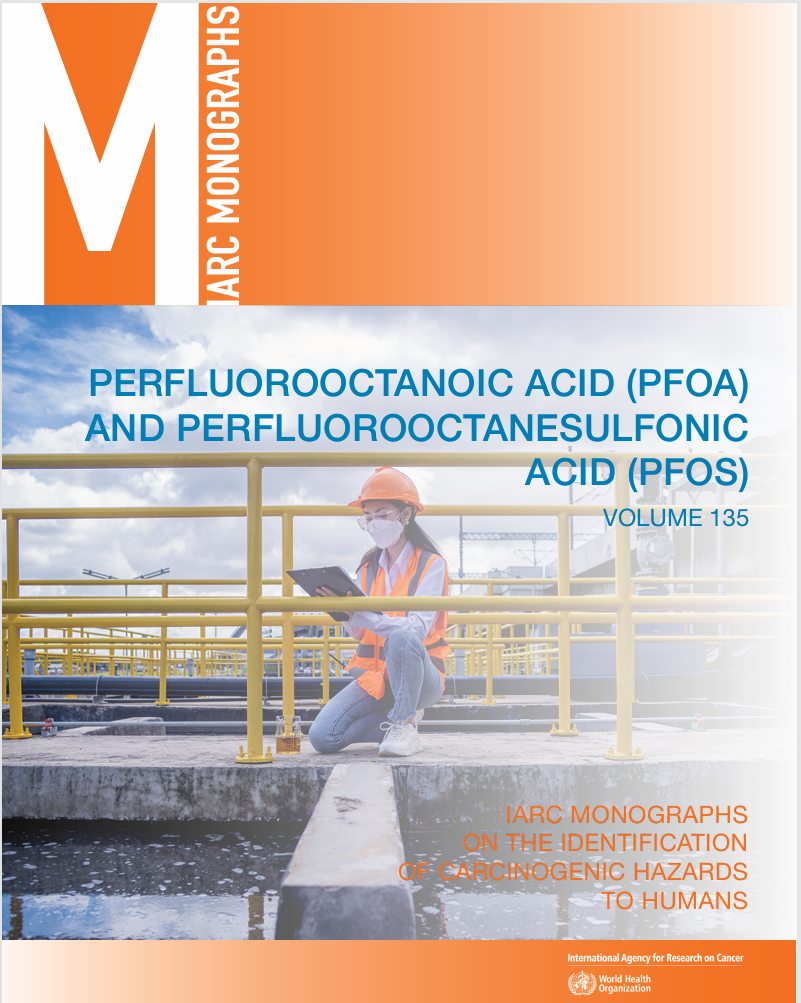
IARC Monographs Volume 135 / Perfluorooctanoic acid (PFOA) and perfluorooctanesulfonic acid (PFOS)
ID 23522 | 26.02.2025 / Attached
This volume of the IARC Monographs provides evaluations of the carcinogenicity of two agents, perfluorooctanoic acid (PFOA) and perfluorooctanesulfonic acid (PFOS), and their corresponding isomers and salts.
PFOA and PFOS are per- and polyfluoroalkyl substances (PFAS) that are extremely resistant to degradation. First produced in the 1940s, PFOA has extensive uses, including in fluoropolymer manufacture and applications; in surface coatings conferring stain-, oil-, and water-resistance on household products, carpets, textiles, leather products, and food and feed packaging; in electrics and electronics; and in construction materials. With some similar uses to those of PFOA, PFOS additionally has applications in aqueous film-forming foams used in firefighting; in the fabrication of imaging devices and semiconductors; in photolithography and electroplating; and in insulation, dyes, and ink.
PFOA and PFOS occur ubiquitously in the environment, with high levels at pollution sources such as industrial sites and in firefighter-training areas and waste deposits. They may also be present in contaminated food, especially fish, seafood, and eggs. Occupationally exposed populations can have high levels of exposure, mainly via inhalation. The general population in contaminated areas is mainly exposed via drinking-water, and the general population in communities that are not near pollution sources is mainly exposed via diet and drinking-water.
Conclusions
An IARC Monographs Working Group reviewed evidence from epidemiological studies, cancer bioassays in experimental animals, and mechanistic studies to assess the carcinogenic hazard to humans of exposure to these agents and concluded that:
- PFOA is carcinogenic to humans (Group 1);
- PFOS is possibly carcinogenic to humans (Group 2B).
...
Collegati
Allegati
|
Descrizione |
Lingua |
Dimensioni |
Downloads |
 |
|
EN |
16617 kB |
834 |