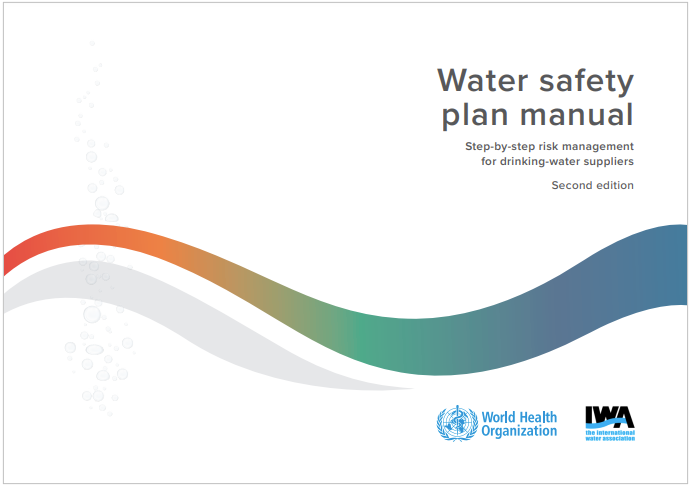
Water Safety Plans Manual - Step-by-step risk management for drinking-water suppliers / 2nd March 2023
ID 19394 | 08.04.2023 / In allegato
1nd Edition WHO 2009
2nd Edition WHO 2023 / Toolbox
1nd Edition WHO 2023
In 2004, the WHO Guidelines for Drinking Water Quality recommended that water suppliers develop and implement "Water Safety Plans" (WSPs) in order to systematically assess and manage risks. Since this time, governments and regulators, water suppliers and practitioners have increasingly embraced this approach, but they have also requested further guidance.
This WSP manual answers this call by describing how to develop and implement a WSP in clear and practical terms. Stepwise advice is provided through 11 learning modules, each representing a key step in the WSP development and implementation process.
2nd Edition WHO 2023
This Water safety plan manual provides practical guidance to support development and implementation of water safety planning in accordance with the principles presented in the WHO Guidelines for drinking-water quality.
The manual is targeted at water suppliers and organizations supporting water safety planning programmes, including government agencies responsible for public health, or regulation and surveillance of drinking-water quality, nongovernmental or intergovernmental organizations. The guidance provides a broad range of examples and case studies from lower- to higher-income settings, highlighting practical solutions to real-world challenges from around the globe to help readers apply the guidance in diverse contexts.
This second edition streamlines guidance on the integration of climate resilience and equity into the water safety planning approach, to help support access to safely managed drinking-water services for all users, despite growing uncertainties from a changing climate.
The fourth edition incorporating the first and second addenda, of the World Health Organization’s (WHO) Guidelines for drinking-water quality (GDWQ) builds on over 60 years of guidance by WHO on drinking-water quality, which has formed an authoritative basis for the setting of national regulations and standards for water safety in support of public health.
It is the product of significant revisions to clarify and elaborate on ways of implementing its recommendations of contextual hazard identification and risk management, through the establishment of health-based targets, catchment-to-consumer water safety plans and independent surveillance.
Updates in this latest edition reflect new evidence and further, provides additional explanations to support better understanding and application of the guidance. More details on the updates are included in the GDWQ preface.
Guidance has been updated on a number of chemicals: asbestos, bentazone, chromium, iodine, manganese, microcystins, nickel, silver, tetrachloroethene and trichloroethene. Guidance has also been added for chemicals not previously assessed in the Guidelines: anatoxin-a and analogues, cylindrospermopsins and saxitoxins. The new guidance on organotins has replaced the prior guidance focused on dialkyltins. With these updates, the guideline values for tetrachloroethene and trichloroethene have been revised while new guideline values for cylindrospermopsins, manganese, microcystins, and saxitoxins have been established .
Updated information on cyanobacteria has been included, introducing an alert level framework for early-warning and to guide short-term management responses. Guidance has also been updated in the sections on adequacy of water supply, climate change, emergencies, food production and processing, and radiological aspects, particularly on managing radionuclides when exceeding WHO screening values and guidance levels.
Complementary guidance
The Aquatown water safety plan: worked example is an extract of a water safety plan to support implementation of the guidance provided in the Water safety plan manual, second edition.
Water safety plan templates / Toolbox
These templates can support early-stage WSP teams to get started. They should be used in conjunction with the guidance provided in the Water safety plan manual, second edition.
Module 1: WSP team membership and meeting templates
Module 4: Risk assessment table template
Module 5: Improvement plan template
Module 6: Operational monitoring templates
Module 7: Compliance monitoring template
Module 8: Management procedure templates
Collegati
Allegati
|
Descrizione |
Lingua |
Dimensioni |
Downloads |
 |
|
EN |
121 kB |
21 |
 |
|
EN |
1304 kB |
41 |
|
|
|
EN |
3249 kB |
40 |
|
|
|
EN |
1710 kB |
7 |