

~ 2000 / 2026 ~
// Documenti disponibili n:
49.532
// Documenti scaricati n:
42.776.075
// Newsletter n:
4640















Featured
EU CBRNe Glossary
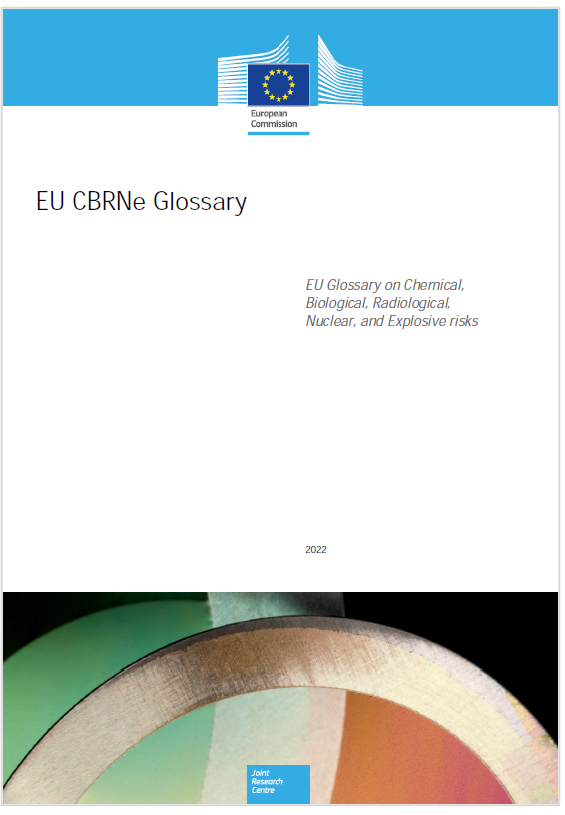
EU CBRNe Glossary / JRC 2022
ID 25370 | 20.01.2026 / In allegato
EU Glossary on Chemical, Biological, Radiological, Nuclear, and Explosive risks (CBRNe)
The EU CBRNe Glossary is the EU official glossary on chemical, biological, radiological, nuclear, and explosive risks (CBRNe).
It is an information tool for practitioners in CBRNe management and response developed by the European Commission.
The aim is to achieve a common understanding of terms related to CBRNe areas and facilitate the work of all intervenients in CBRNe-related activities not only within the European Union, but also outside its borders.
__________
EU CBRNe Glossary
A1 and A2
Are categories to determine the type of packaging for transport of radioactive material. The categories are corresponding to the maximum activity, expressed in Becquerel.
- A1 refers to a non-dispersible solid radioactive material or a sealed capsule containing radioactive material,
- A2 refers to the normal form of radioactive material.
The maximum Bequerel values for A1 o A2 differ for various nuclides
See: ADR.
ADR
European Agreement concerning the International Carriage of Dangerous Goods by Road (ADR) stipulates that the trans boundary road transport of dangerous goods must comply with:
- Annex A as regards the goods, in particular their packaging and labelling; and
- Annex B as regards the construction, equipment and operation of the vehicle carrying the goods
See: Dangerous goods core legislation.
ADR classes
See: Classes of dangerous goods.
ADR labels
The regulations for the transport of dangerous goods (ADR) specify that hazard labels are diamond-shaped (i.e. squares set at an angle of 45°), in distinctive colours, and contain a hazard symbol. A label may also contain a class number, a UN number, or a word or phrase describing the hazard (e.g. FLAMMABLE).
AEGL
An acute exposure guideline level (AEGL) is a toxicologically substantiated maximum exposure level intended for the protection of the general public against an once-in-a-lifetime, or rare, exposure to airborne chemicals.
It represents the airborne concentration of a substance at or above which it is predicted that the general population could experience:
1. notable discomfort (AEGL-1);
2. irreversible or other serious, long lasting effect or an impaired ability to escape (AEGL-2); or
3. life-threatening effects or death (AEGL-3) See: Exposure limits for chemicals.
See: Exposure limits for chemicals.
....
EC 2022
add attached

Certifico s.r.l.
Sede: Via A. De Curtis, 28 - 06135 Perugia - IT
Sede: Via Madonna Alta 138/A - 06128 Perugia - IT
P. IVA: IT02442650541
Tel. 1: +39 075 599 73 63
Tel. 2: +39 075 599 73 43
Assistenza: 800 14 47 46
www.certifico.com
info@certifico.com
Sede: Via Madonna Alta 138/A - 06128 Perugia - IT
P. IVA: IT02442650541
Tel. 1: +39 075 599 73 63
Tel. 2: +39 075 599 73 43
Assistenza: 800 14 47 46
www.certifico.com
info@certifico.com
Testata editoriale iscritta al n. 22/2024 del registro periodici della cancelleria del Tribunale di Perugia in data 19.11.2024