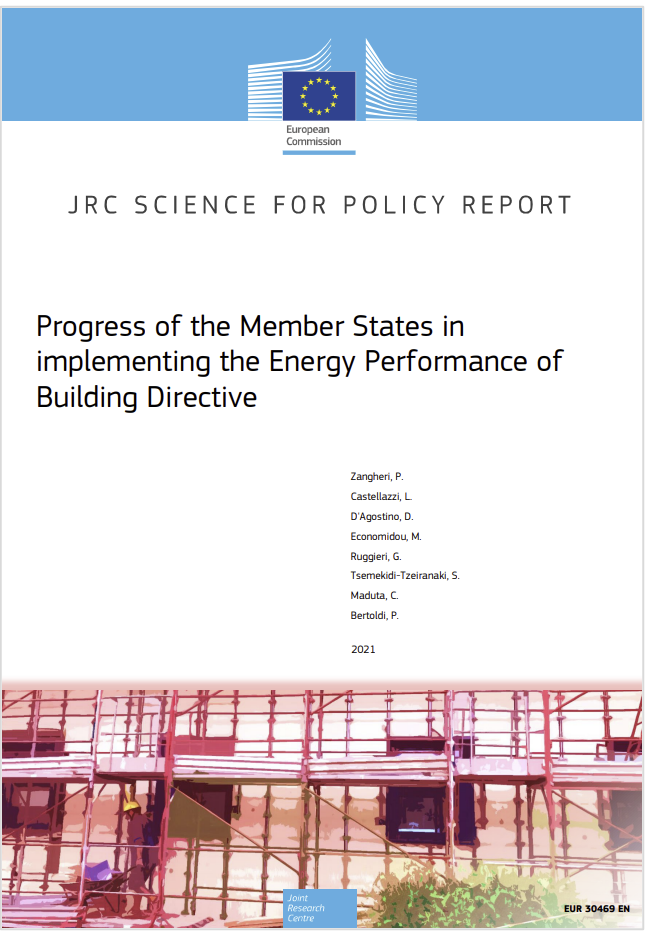
Progress of the Member States in implementing the Energy Performance of Building Directive (EPBD) / JRC 2021
ID 26916 | 17 Agosto 2026 / Allegato
The study indicates that during the period 2005-2018, the final energy consumption of the building sector decreased by 5%. In the residential sector, improvements in energy efficiency as well as warmer winters have led to a 10% reduction in the final energy consumption while in the services sector, the final energy consumption increased by 2% mainly due to economic growth. However, the renovation rate is still very low.
For residential buildings, the annual weighted energy renovation rate was estimated to 1.0% while the rate of deep renovation is much lower with values around 0.2%. The review on the implementation of cost-optimal minimum energy performance requirements indicates that all Member States implemented the EPBD requirements.
Normally as energy performance indicator each State referred to the one already used, to which over time it has added the primary energy consumption. Moreover, the assessment of the Members States progress in implementing the cost optimal calculation reports a rather positive picture regarding the conformity with the requirements of the Delegated Regulation No. 244/2012.
The main gaps are registered for the calculations' scope, the derivation of cost-optimal levels, and the definition of a plan to reduce the gap.
The share of energy certified buildings across Member States is still very low. Only about 10% of the existing buildings have an Energy Performance Certificate. The main identified issues are related to lack of access to reliable information, quality and fair pricing of EPCs, diminishing the trust in this tool. Even though the use of EPCs generally improved after the EPBD recast, it is clear that further changes are needed to make EPCs a reliable information source.
The report reveals that currently 25 Member States have in force a complete Nearly Zero Energy Building definition. NZEB requirements are currently 70% lower than the national minimum energy performance requirements in 2006 showing a consistent trend in increasing building energy efficiency.
Moreover, in comparison with cost-optimal levels the NZEB requirements are significant lower (about -50%) of cost-optimal references, implying that Member States may refer to the cost-optimal approach to define the NZEB requirements.
The assessment of the first 15 submitted LTRSs highlights that almost all the Member States provide a good overview of the building stock and policies to stimulate cost-effective deep renovation, to target worst performing buildings and public buildings and to alleviate energy poverty.
However, less than half of the strategies provide a clear roadmap towards a decarbonised building stock by 2050 while the majority present a high level of ambition, not always supported by comprehensive policies.
The overview of the financial and fiscal instruments supporting energy renovation of buildings across the EU highlights that up until 2019, grants and subsidies were deployed in almost all Member States, representing the main type of public policy support. Soft loans were available in half of the EU countries supported by state guarantees or designed as revolving funds while several Member States offered incentives in the form of income tax incentives or VAT reduction schemes.
add attached
JRC
Zangheri, P. / Castellazzi, L. / D'Agostino, D. / Economidou, M. / Ruggieri, G. / Tsemekidi-Tzeiranaki, S. / Maduta, C. / Bertoldi, P.
Collegati
Allegati
|
Descrizione |
Lingua |
Dimensioni |
Downloads |
 |
|
IT |
1400 kB |
9 |