

~ 2000 / 2026 ~
// Documenti disponibili n:
49.518
// Documenti scaricati n:
42.703.972
// Newsletter n:
4623


















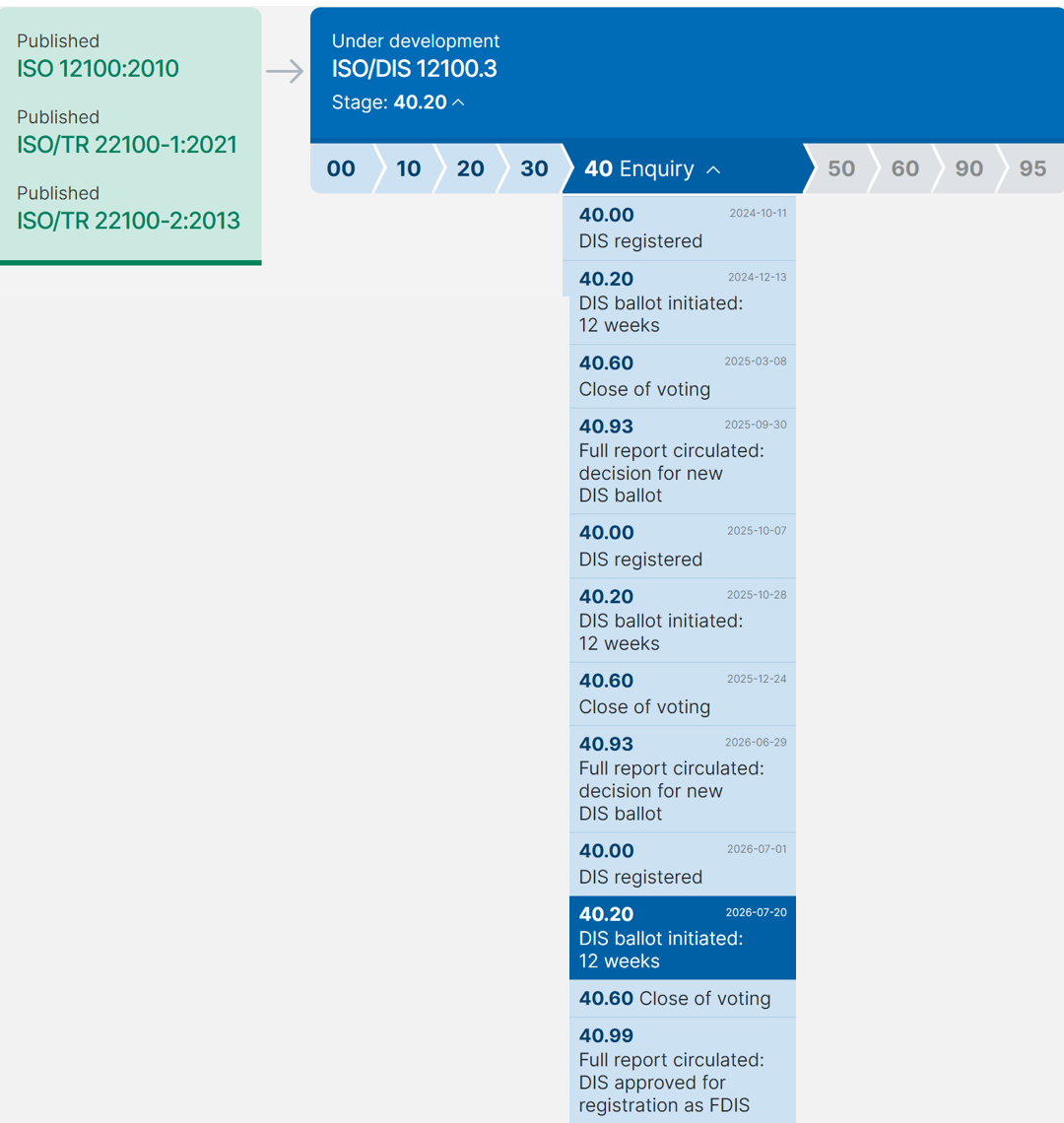
ISO/DIS 12100.3 / DIS ballot initiated 20.07.2026
ID 3739
Per poter visualizzare la newsletter con i dati personalizzati devi essere connesso. Fai click qui per effettuare l'accesso al sito.
| Appunti Normazione | ||
| Newsletter n. 3672 del 21 Luglio 2026 | ||
 |
||
| Salve Visitatore | ||
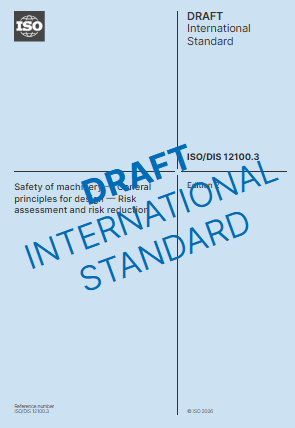
ISO/DIS 12100.3 / DIS ballot initiated 20.07.2026 ID 26621 | Update 21.07.2026 / Preview attached ISO/DIS 12100.3 Status: Under development This Draft International Standard is in the enquiry phase with ISO members. ISO 12100:2010 specifies basic terminology, principles and a methodology for achieving safety in the design of machinery. It specifies principles of risk assessment and risk reduction to help designers in achieving this objective. These principles are based on knowledge and experience of the design, use, incidents, accidents and risks associated with machinery. Procedures are described for identifying hazards and estimating and evaluating risks during relevant phases of the machine life cycle, and for the elimination of hazards or sufficient risk reduction. Guidance is given on the documentation and verification of the risk assessment and risk reduction process. ISO 12100:2010 is also intended to be used as a basis for the preparation of type-B or type-C safety standards. It does not deal with risk and/or damage to domestic animals, property or the environment. Life cycle 20.07.2026
Preview ISO/DIS 12100.3 Foreword ISO (the International Organization for Standardization) is a worldwide federation of national standards bodies (ISO member bodies). The work of preparing International Standards is normally carried out through ISO technical committees. Each member body interested in a subject for which a technical committee has been established has the right to be represented on that committee. International organizations, governmental and non-governmental, in liaison with ISO, also take part in the work. ISO collaborates closely with the International Electrotechnical Commission (IEC) on all matters of electrotechnical standardization. The procedures used to develop this document and those intended for its further maintenance are described in the ISO/IEC Directives, Part 1. In particular, the different approval criteria needed for the different types of ISO document should be noted. This document was drafted in accordance with the editorial rules of the ISO/IEC Directives, Part 2 (see www.iso.org/directives). ISO draws attention to the possibility that the implementation of this document may involve the use of (a) patent(s). ISO takes no position concerning the evidence, validity or applicability of any claimed patent rights in respect thereof. As of the date of publication of this document, ISO had not received notice of (a) patent(s) which may be required to implement this document. However, implementers are cautioned that this may not represent the latest information, which may be obtained from the patent database available at www.iso.org/patents. ISO shall not be held responsible for identifying any or all such patent rights. Any trade name used in this document is information given for the convenience of users and does not constitute an endorsement. For an explanation of the voluntary nature of standards, the meaning of ISO specific terms and expressions related to conformity assessment, as well as information about ISO's adherence to the World Trade Organization (WTO) principles in the Technical Barriers to Trade (TBT), see www.iso.org/iso/foreword.html. This document was prepared by Technical Committee ISO/TC 199, Safety of machinery, in collaboration with the European Committee for Standardization (CEN) Technical Committee CEN/TC 114, Safety of machinery, in accordance with the Agreement on technical cooperation between ISO and CEN (Vienna Agreement). This second edition of ISO 12100 cancels and replaces ISO 12100:2010, ISO/TR 22100-1:2021 and ISO/TR 22100-2:2013. The main changes are as follows: - the Scope has been modified; In addition to text written in the official ISO languages (English, French, Russian), this document gives text in German. This text is published under the responsibility of the member body for Germany (DIN) and is given for information only. Only the text given in the official languages can be considered as ISO text. Any feedback or questions on this document should be directed to the user’s national standards body. A complete listing of these bodies can be found at www.iso.org/members.html. Introduction The primary purpose of this document is to provide designers with an overall framework and guidance for decisions during the development of machinery to enable them to design machines that are adequately safe for their intended use. It also provides a strategy for standards developers and will assist in the preparation of consistent and appropriate type-B and type-C standards. The concept of safety of machinery considers the ability of a machine to perform its intended function(s) during its lifecycle where risk has been adequately reduced. This document is the basis for a set of standards which has the following structure: a) type-A standards (basic safety standards) giving basic concepts, principles for design, and general aspects that can be applied to all machinery; This document is a type-A standard. This document is of relevance, in particular, for the following stakeholder groups representing the market players with regard to machinery safety: - machine manufacturers (small, medium and large enterprises); Others can be affected by the level of machinery safety achieved with the means of the document by the above-mentioned stakeholder groups: - machine users/employers (small, medium and large enterprises); The above-mentioned stakeholder groups have been given the possibility to participate in the drafting process of this document. When a type-C standard deviates from one or more technical provisions dealt with by this document or by a type-B standard, the type-C standard takes precedence. It is desirable that this document be referred to in training courses and manuals to convey basic terminology and general design methods to designers. ISO/IEC Guide 51 has been taken into account as far as practicable at the time of drafting of this document. A trilingual lookup and index of specific terms and expressions used in this document is given in Annex E. 1 Scope This document defines basic terminology and specifies principles and a methodology for safety in the design of machinery. It specifies principles of risk assessment and risk reduction to help designers in achieving this objective. These principles are based on knowledge and experience of the design, use, incidents, accidents and risks associated with machinery. Procedures are described for identifying hazards and estimating and evaluating risks during relevant phases of the machine lifecycle, and for the elimination of hazards or the provision of adequate risk reduction. Guidance is given on the documentation and verification of the risk assessment and risk reduction process. This document covers principal implications on machinery safety in case of implementation of artificial intelligence/machine learning, and vulnerability to cyber threats and data corruption regarding their impact on safety. It specifies generic measures to address both aspects. Safety of machinery includes hygiene aspects. This document is also intended to be used as a basis for the preparation of type-B or type-C safety standards. This document covers neither risk nor damage to domestic animals, property or the environment. NOTE 1 While this document refers to risks of harm to persons, the risk assessment process set out in this document can be equally effective in assessing other types of risks such as damage to domestic animals, property or the environment. NOTE 2 Annex B gives, in separate tables, examples of hazards, hazardous situations and hazardous events, in order to clarify these concepts and assist the designer in the process of hazard identification. NOTE 3 The practical use of a number of methods for each stage of risk assessment is described in ISO/TR 14121-2. NOTE 4 As used in this document, the designer of a machine can include the manufacturer, integrator, supplier, or the user in case of safety-relevant modifications. NOTE 5 This document can also be used for existing machinery. 2 Normative references The following documents are referred to in the text in such a way that some or all of their content constitutes requirements of this document. For dated references, only the edition cited applies. For undated references, the latest edition of the reference document (including any amendments) applies. ISO/DIS 12895-2:2025 Safety of machinery - Identification of whole body access and prevention of associated risk(s) ISO 13849-1:2023 Safety of machinery - Safety-related parts of control systems - Part 1: General principles for design ISO 20607 Safety of machinery - Instruction handbook - General drafting principles 3 Terms and definitions For the purposes of this document, the following terms and definitions apply. ISO and IEC maintain terminology databases for use in standardization at the following addresses: - ISO Online browsing platform: available at https://www.iso.org/obp - IEC Electropedia: available at https://www.electropedia.org/ 3.1 machinery machine assembly, fitted with or intended to be fitted with a drive system other than directly applied human or animal effort, consisting of linked parts or components, at least one of which moves, and which are joined together for a specific application Note 1 to entry: The term “machinery” can include an assembly of machines, which achieves the same purpose, when they are arranged and controlled to function as an integral whole. Note 2 to entry: Annex A provides a general schematic representation of a machine. 3.2 reliability ability of a machine or its components or equipment to perform a required function under specified conditions and for a given period of time without failing 3.3 maintainability characteristic of a machine that allows it to be kept in a state which enables it to fulfil its function under conditions of intended use, or to be restored to such a state 3.4 usability characteristic of a machine that allows it to be easily used including properties or characteristics that enable its function(s) to be easily understood 3.5 harm physical injury or damage to health 3.6 hazard potential source of harm Note 1 to entry: The term “hazard” can be qualified in order to define its origin (e.g. mechanical hazard, electrical hazard) or the nature of the potential harm (e.g. electric shock hazard, cutting hazard, toxic hazard, fire hazard). Note 2 to entry: The hazard envisaged by this definition either: - is permanently present during the intended use of the machine (e.g. motion of hazardous moving elements, electric arc during a welding phase, unhealthy posture, noise emission, high temperature); or - can appear unexpectedly (e.g. explosion, crushing hazard as a consequence of an unintended/unexpected start-up, ejection as a consequence of a breakage, fall as a consequence of acceleration/deceleration). 3.7 significant hazard hazard which has been identified as associated with the machine and which requires specific action to eliminate or to reduce its risk in accordance with the risk assessment Note 1 to entry: This term is included as basic terminology for type-B and type-C standards. Note 2 to entry: The prior term "relevant hazard" is included as being a significant hazard. 3.8 hazardous event event that can cause harm Note 1 to entry: A hazardous event can occur over a short period of time or over an extended period of time. 3.9 hazardous situation circumstance in which a person is exposed to at least one hazard Note 1 to entry: The exposure can result in harm immediately or over a period of time. 3.10 hazard zone danger zone any space either within or around machinery, or both, in which a person can be exposed to a hazard 3.11 risk combination of the probability of occurrence of harm and the severity of that harm 3.12 residual risk risk remaining after risk reduction measures have been implemented Note 1 to entry: This document distinguishes: - the residual risk after risk reduction measures have been implemented by the designer; - the residual risk remaining after all risk reduction measures by the designer and the user have been implemented. Note 2 to entry: See also Figure 3. 3.13 risk estimation defining likely severity of harm and probability of its occurrence 3.14 risk analysis combination of the specification of the limits of the machine, hazard identification and risk estimation 3.15 risk evaluation procedure based on the risk analysis to determine whether further risk reduction is required [SOURCE: ISO/IEC Guide 51:2014, 3.12, modified - The wording “tolerable risk has been exceeded” has been replaced with “further risk reduction is required”.] 3.16 risk assessment overall process comprising a risk analysis and a risk evaluation Note 1 to entry: See Figure 1. 3.17 risk reduction measure DEPRECATED:protective measure action or means to eliminate hazards or reduce risks Note 1 to entry: See Figure 2 and Figure 3. 3.18 complementary risk reduction measure risk reduction measure used in conjunction with inherently safe design, safeguarding or information for use to enhance risk reduction 3.19 tolerable risk acceptable risk adequately reduced risk level of risk that is accepted in a given context based on the current values of society at a minimum in accordance with legal requirements Note 1 to entry: Tolerable risk usually refers to the level at which further technologically, functionally and financially feasible risk reduction measures or additional expenditure(s) of resources will not result in significant reduction in risk. Note 2 to entry: Criteria for determining when adequately reduced risk is achieved are given in 5.6.2. Fonte: ISO Collegati 
|
||
 |
||
|
sono siti di: Se vuoi cancellarti dall'invio della newsletter clicca qui oppure effettua il login al sito ed entra nella Tua Area Riservata, in “Modifica dati” agisci con la spunta sul box di selezione “newsletter”. L'elenco completo di tutte le ns newsletter è qui: Archivio newsletter certifico.com
Testata editoriale iscritta al n. 22/2024 registro periodici Tribunale di Perugia 19.11.2024 |
||
   |
||
 |
||
| Certifico Srl 2000-2026 | VAT IT02442650541 | ||

Certifico s.r.l.
Sede: Via A. De Curtis, 28 - 06135 Perugia - IT
Sede: Via Madonna Alta 138/A - 06128 Perugia - IT
P. IVA: IT02442650541
Tel. 1: +39 075 599 73 63
Tel. 2: +39 075 599 73 43
Assistenza: 800 14 47 46
www.certifico.com
info@certifico.com
Sede: Via Madonna Alta 138/A - 06128 Perugia - IT
P. IVA: IT02442650541
Tel. 1: +39 075 599 73 63
Tel. 2: +39 075 599 73 43
Assistenza: 800 14 47 46
www.certifico.com
info@certifico.com
Testata editoriale iscritta al n. 22/2024 del registro periodici della cancelleria del Tribunale di Perugia in data 19.11.2024