


Quaderni dell'efficienza energetica - VETRO

Quaderni dell'efficienza energetica - VETRO
ID 15910 | 27.02.2022 / ENEA 2021
La pubblicazione rappresenta una guida operativa per la redazione di una diagnosi energetica di qualità per il settore dell’...


















ID 25771 | 17.03.2026 / Attached
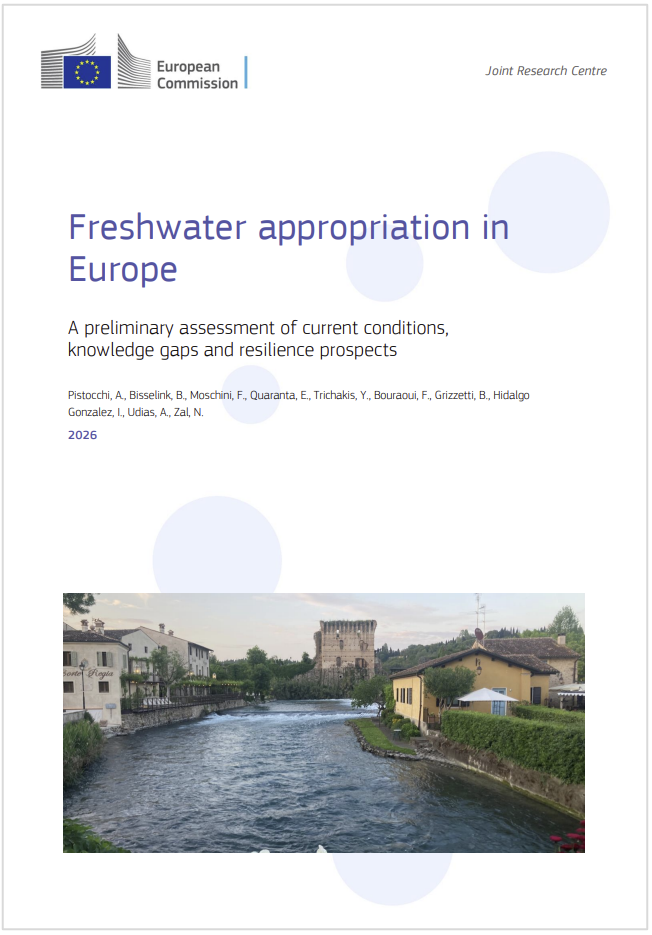
A preliminary assessment of current conditions, knowledge gaps and resilience prospects
In this contribution, we analyze the level of water appropriation in European watersheds, using available estimates of water demand and water availability to compute the ratio of demand to availability in the European Union’s river basins.
We highlight that demands are more uncertain than availability and deserve further research. Nevertheless, currently available estimates enable a screening level assessment. Water demand usually represents 10-50% of renewable water availability and may even exceed 100% in some regions, implying direct or indirect water reuse in the river basin, use of non-renewable water or transfers among river basins.
The level of water appropriation varies significantly across Europe, generally with a North-South gradient in line with other assessments, reflecting the interplay between demand and availability.
The patterns of potential appropriation depend on the water-using sectors. Irrigation systematically occurs in highly appropriated river basins and tends to be the main driver of water appropriation. Most central European regions show relatively uniform mixes of water demand, but energy or irrigation may become dominant in northern or southern regions, respectively.
Climate change will exacerbate the current situation particularly for irrigation and livestock. There is a widespread potential for reuse of water across sectors, which may contribute substantially to water resilience
...
Joint Research Centre 2026
Pistocchi, A., Bisselink, B., Moschini, F., Quaranta, E., Trichakis, Y., Bouraoui, F., Grizzetti, B., Hidalgo
Gonzalez, I., Udias, A., Zal, N.
ID 15910 | 27.02.2022 / ENEA 2021
La pubblicazione rappresenta una guida operativa per la redazione di una diagnosi energetica di qualità per il settore dell’...
Direttiva 91/414/CEE del Consiglio, del 15 luglio 1991, relativa all'immissione in commercio dei prodotti fitosanitari
(GU L 230 del 19.8.1991)
Abrogata da: Regolamento (CE) n. 1107/...
Criteri e norme tecniche generali per la disciplina regionale dell'utilizzazione agronomica degli effluenti di allevamento, di cui all'articolo 38 del decreto legislativo 11 maggi...
Testata editoriale iscritta al n. 22/2024 del registro periodici della cancelleria del Tribunale di Perugia in data 19.11.2024